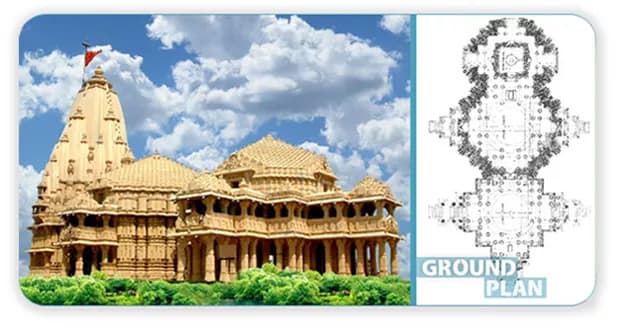
Somnath Temple
The sacred Somnath Temple — one of the twelve Jyotirlingas — was reconstructed after India's Independence under the architectural leadership of Shri Janak M Sompurabhai Oghadbhai Sompura, entrusted by Sardar Vallabhbhai Patel.

The Story
About This Sacred Structure
The sacred Somnath Temple — one of the twelve Jyotirlingas — was reconstructed after India's Independence under the architectural leadership of Shri Janak M Sompurabhai Oghadbhai Sompura, entrusted by Sardar Vallabhbhai Patel.
Consequent upon the Independence of India in 1947, the historic responsibility of planning and constructing the grand Shri Somnath Maha Meru Prasad was entrusted by Sardar Vallabhbhai Patel to the renowned temple architect Shri Janak M Sompurabhai Oghadbhai Sompura. This monumental and devotional undertaking led to the creation of the Maha Meru Prasad — a Sandhar Prasad representing the divine abode of Lord Shiva. The structure includes a circular inner pradakshina path for devotees, seven ascending levels crowned by a summit, and two mandaps — the Gudh Mandap and Nritya Mandap — open from the sides with an ornate eastern entrance crafted from seriaj stone. The Nritya Mandap was recently extended and inaugurated. Built in the traditional Nagar style, the temple stands as a magnificent revival of a shrine that had been destroyed and rebuilt multiple times through history. As one of the twelve Jyotirlingas, it holds immense religious significance. Ongoing beautification efforts include enhancements to the pradakshina path, red stone pagathi steps, fountains, and landscaped surroundings, further elevating the temple's spiritual and architectural grandeur.
Somnath Temple
Project Overview
- Style
- Nagara
- Location
- Veraval, Gujarat
- Year
- 1951
- Duration
- 8 years
- Artisans
- 2,000+
- Material
- Seriaj Stone
- Height
- 55m
- Status
- Completed
Gallery
In Every Carved Detail
The Craft
How This Temple Was Built
Every Sompura temple follows a five-stage process rooted in the ancient SHILP Shastra texts — from the first survey of the land to the final sacred consecration.
Primary Material
Seriaj Stone
Artisans Involved
2,000+
Construction Period
8 years
Site & Vastu Analysis
Every project begins with a thorough Vastu analysis — assessing cardinal alignment, soil quality, water table, and the subtle energetic properties of the land.
Sacred Drawing (Rekha)
Master Sthapatis produce hand-drawn plans based on Manasara and Mayamata proportional canons. Every column, shikhara, and doorway follows precise mathematical ratios.
Stone Selection
Stone is chosen based on grain, hardness, and acoustic properties. Sandstone, marble, and granite are assessed at the quarry before transport to the carving yard.
Hand Carving
Hereditary craftsmen carve each panel and deity by hand using traditional tools — chisels, hammers, and adzes passed down through generations of shilpis.
Assembly & Consecration
Stone panels are assembled using traditional dry-joint mortise and tenon connections — no cement. The structure is completed with Prana Pratishtha, the sacred consecration ritual.
More Projects
Related Temples
Start Your Project
Begin Your Sacred Project
Whether you are commissioning a new temple, restoring a heritage structure, or seeking sacred architectural guidance — our masters are ready to listen, advise, and create.