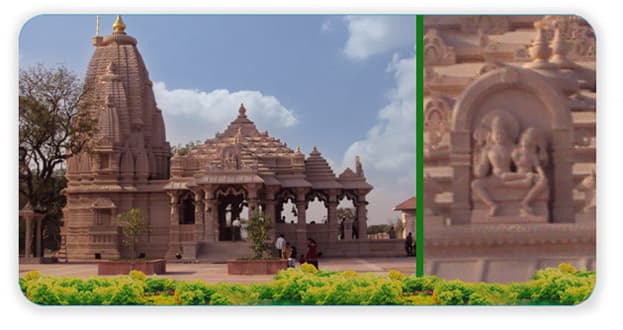
Koteshavar Mahadev Temple
A beautifully carved Bansipaharpur stone temple built on the banks of the Sabarmati river, enhanced by a splendid 60ft deep landscaped fill.

The Story
About This Sacred Structure
A beautifully carved Bansipaharpur stone temple built on the banks of the Sabarmati river, enhanced by a splendid 60ft deep landscaped fill.
Originally a small temple with immense spiritual resonance, this sacred site sits beautifully on the banks of the Sabarmati river. Shree B.L. Sharmaji, having visited the temple, felt deeply inspired by the divine and envisioned building a far more beautiful and structurally grand temple in its place. The resulting architectural piece stands as one of the finest works crafted in Bansipaharpur stone, adorned with beautiful and intricate carvings throughout. To accommodate the grand vision and properly secure the riverside location, the surrounding land had to be significantly raised, requiring filling up to a depth of 60'0". This extensive groundwork allowed for the creation of a splendid, elevated landscaped view right by the river. The ambitious project commenced in the year 2009 and, through dedicated effort, was successfully completed within a short span of just 2 years in 2011.
Koteshavar Mahadev Temple
Project Overview
- Style
- Traditional
- Location
- Koteshwar, Gujarat
- Year
- 2011
- Duration
- 2 years (2009-2011)
- Artisans
- Traditional Craftsmen
- Material
- Bansipaharpur Stone
- Height
- Riverside Landscape
- Status
- Completed
Gallery
In Every Carved Detail
The Craft
How This Temple Was Built
Every Sompura temple follows a five-stage process rooted in the ancient SHILP Shastra texts — from the first survey of the land to the final sacred consecration.
Primary Material
Bansipaharpur Stone
Artisans Involved
Traditional Craftsmen
Construction Period
2 years (2009-2011)
Site & Vastu Analysis
Every project begins with a thorough Vastu analysis — assessing cardinal alignment, soil quality, water table, and the subtle energetic properties of the land.
Sacred Drawing (Rekha)
Master Sthapatis produce hand-drawn plans based on Manasara and Mayamata proportional canons. Every column, shikhara, and doorway follows precise mathematical ratios.
Stone Selection
Stone is chosen based on grain, hardness, and acoustic properties. Sandstone, marble, and granite are assessed at the quarry before transport to the carving yard.
Hand Carving
Hereditary craftsmen carve each panel and deity by hand using traditional tools — chisels, hammers, and adzes passed down through generations of shilpis.
Assembly & Consecration
Stone panels are assembled using traditional dry-joint mortise and tenon connections — no cement. The structure is completed with Prana Pratishtha, the sacred consecration ritual.
More Projects
Related Temples
Start Your Project
Begin Your Sacred Project
Whether you are commissioning a new temple, restoring a heritage structure, or seeking sacred architectural guidance — our masters are ready to listen, advise, and create.