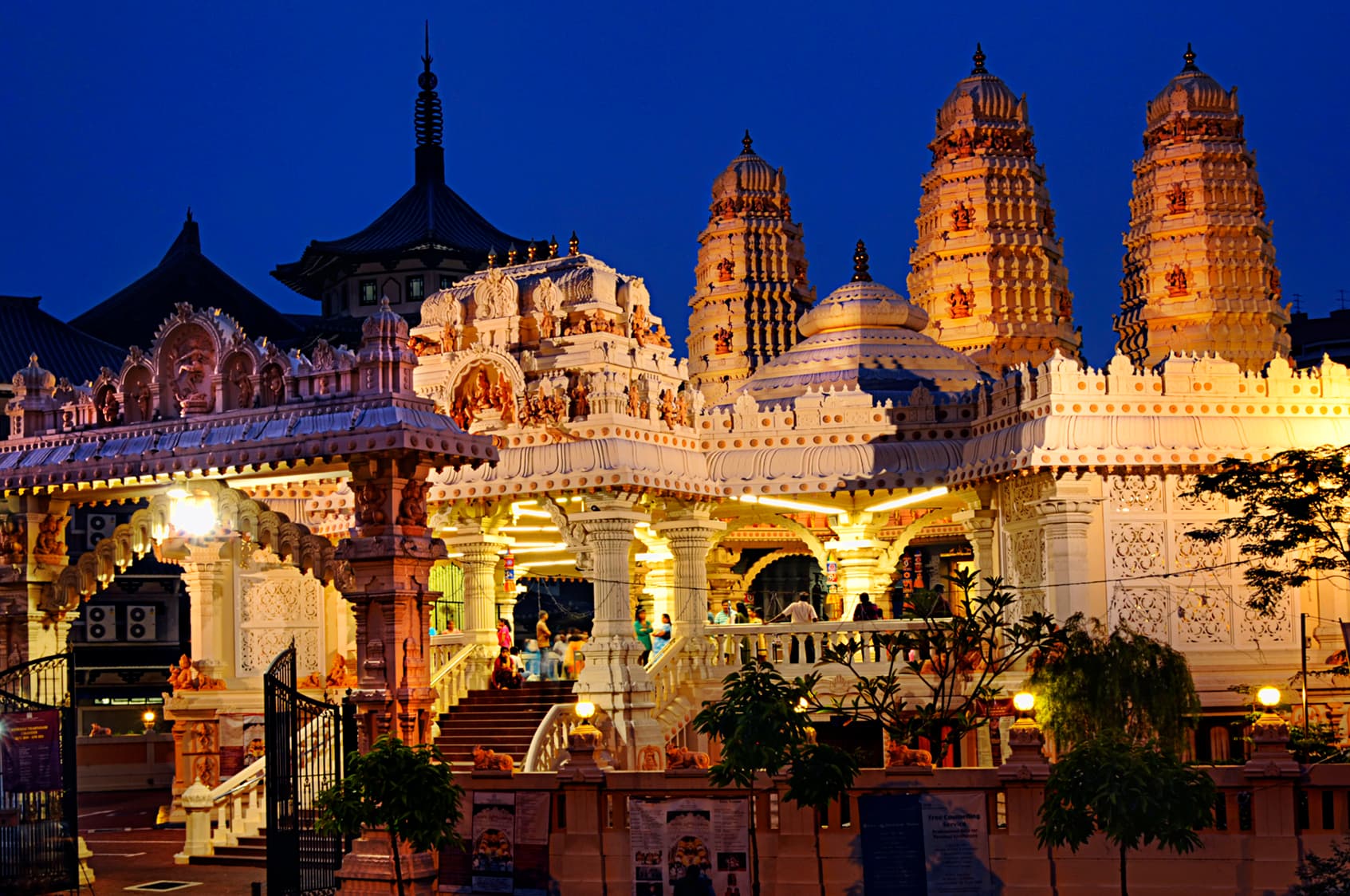
Shiv Temple
A modern Shivalaya replacing an older temple, featuring a unique synthesis of North Indian Nagara and South Indian architectural styles.

The Story
About This Sacred Structure
A modern Shivalaya replacing an older temple, featuring a unique synthesis of North Indian Nagara and South Indian architectural styles.
Prior to the implementation of the Tube-train project in Singapore, an old Shivalaya existed in its periphery. The government requested the Hindu Endowment Board to relocate the temple, providing cash compensation and an alternative plot. Consequently, the Board decided to construct a modern Shivalaya. Hon. S.K. Birlaji was approached to oversee the planning, and in 1990, Shri Sompura prepared the designs. These plans uniquely depicted a holy synthesis of North and South Indian styles of temple architecture. Approved by the authorities, construction commenced in 1991 using concrete and locally available stone. The project culminated in 1993 with the Pran-Pratistha of the Shivlinga in this grand new structure. While fundamentally designed in the North Indian Nagara style, the execution by local and South Indian artisans resulted in distinct South Indian touches throughout the plan. The main temple hall measures 80' x 80' in square dimensions and houses three 'Garbh-Gruhas' (sanctum sanctorums). The main interior enshrines Lord Shiva, the second Shri Ganesha, and the third Kartik Swami. Open from all sides, part of the layout includes covered areas specifically designed to preserve the idols during ceremonial processions.
Shiv Temple
Project Overview
- Style
- Nagara & South Indian Synthesis
- Location
- Singapore
- Year
- 1995
- Duration
- 4 years (1991-1995)
- Artisans
- Local & South Indian Artisans
- Material
- Concrete and locally available stone
- Status
- Completed
Gallery
In Every Carved Detail
The Craft
How This Temple Was Built
Every Sompura temple follows a five-stage process rooted in the ancient SHILP Shastra texts — from the first survey of the land to the final sacred consecration.
Primary Material
Concrete and locally available stone
Artisans Involved
Local & South Indian Artisans
Construction Period
4 years (1991-1995)
Site & Vastu Analysis
Every project begins with a thorough Vastu analysis — assessing cardinal alignment, soil quality, water table, and the subtle energetic properties of the land.
Sacred Drawing (Rekha)
Master Sthapatis produce hand-drawn plans based on Manasara and Mayamata proportional canons. Every column, shikhara, and doorway follows precise mathematical ratios.
Stone Selection
Stone is chosen based on grain, hardness, and acoustic properties. Sandstone, marble, and granite are assessed at the quarry before transport to the carving yard.
Hand Carving
Hereditary craftsmen carve each panel and deity by hand using traditional tools — chisels, hammers, and adzes passed down through generations of shilpis.
Assembly & Consecration
Stone panels are assembled using traditional dry-joint mortise and tenon connections — no cement. The structure is completed with Prana Pratishtha, the sacred consecration ritual.
More Projects
Related Temples
Start Your Project
Begin Your Sacred Project
Whether you are commissioning a new temple, restoring a heritage structure, or seeking sacred architectural guidance — our masters are ready to listen, advise, and create.