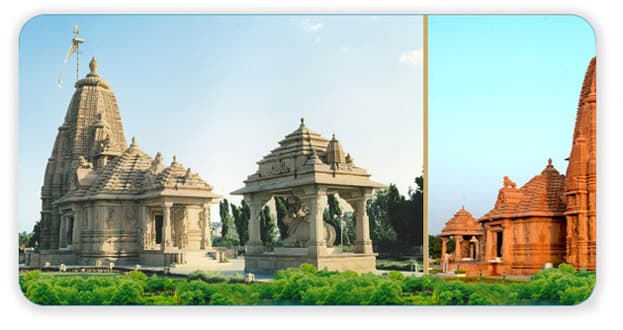
Shri Renukuteshwar Mahadev Mandir
Built within the Hindalco premises at Renukut, Shri Renukuteshwar Mahadev Mandir was constructed between 1967–1972 in the traditional Orissa temple style using Mirzapur pink stone.

The Story
About This Sacred Structure
Built within the Hindalco premises at Renukut, Shri Renukuteshwar Mahadev Mandir was constructed between 1967–1972 in the traditional Orissa temple style using Mirzapur pink stone.
The prominent Hindalco industrial plant at Renukut, established under the leadership of industrialist Shri Birlaji, follows a long-standing tradition of building temples for the spiritual well-being of workers and surrounding communities. In keeping with this vision, the Shri Renukuteshwar Mahadev Mandir project was initiated in 1967 within the Hindalco premises and completed in 1972. Constructed using pink stone sourced from Mirzapur near Renukut, the temple stands gracefully atop a hill, enhancing its natural surroundings. Hon. Birlaji envisioned the temple in the traditional Orissa (Kalinga) architectural style, which was faithfully incorporated into its design. The temple includes a dedicated Pratolya entrance and a special Mandap, while its exterior is adorned with Mandowar-style wall treatments, reflecting classical temple aesthetics and craftsmanship.
Shri Renukuteshwar Mahadev Mandir
Project Overview
- Style
- Kalinga (Orissa Style)
- Location
- Renukut, Uttar Pradesh
- Year
- 1972
- Duration
- 5 years
- Artisans
- Traditional Sompura Craftsmanship
- Material
- Pink Mirzapur Stone
- Height
- Hilltop Temple
- Status
- Completed
Gallery
In Every Carved Detail
The Craft
How This Temple Was Built
Every Sompura temple follows a five-stage process rooted in the ancient SHILP Shastra texts — from the first survey of the land to the final sacred consecration.
Primary Material
Pink Mirzapur Stone
Artisans Involved
Traditional Sompura Craftsmanship
Construction Period
5 years
Site & Vastu Analysis
Every project begins with a thorough Vastu analysis — assessing cardinal alignment, soil quality, water table, and the subtle energetic properties of the land.
Sacred Drawing (Rekha)
Master Sthapatis produce hand-drawn plans based on Manasara and Mayamata proportional canons. Every column, shikhara, and doorway follows precise mathematical ratios.
Stone Selection
Stone is chosen based on grain, hardness, and acoustic properties. Sandstone, marble, and granite are assessed at the quarry before transport to the carving yard.
Hand Carving
Hereditary craftsmen carve each panel and deity by hand using traditional tools — chisels, hammers, and adzes passed down through generations of shilpis.
Assembly & Consecration
Stone panels are assembled using traditional dry-joint mortise and tenon connections — no cement. The structure is completed with Prana Pratishtha, the sacred consecration ritual.
More Projects
Related Temples
Start Your Project
Begin Your Sacred Project
Whether you are commissioning a new temple, restoring a heritage structure, or seeking sacred architectural guidance — our masters are ready to listen, advise, and create.